
Context
At Chaos Cylindo, I worked on a six-month exploration of AI-generated lifestyle imagery for e-commerce. I designed the experience from user flows and wireframes to final screens and an interactive Figma prototype. The project was paused before launch.
Support a workspace and a product-page task.
The exploration focused on two jobs: creating lifestyle images for several products in a dedicated workspace, and generating a missing image while preparing an individual product page. The challenge was to support both contexts while keeping generation, review and reuse of images understandable.
Generation, review and reuse.
I mapped the generation and image-reuse flows in Figma, then used the map to align stakeholders on screen responsibilities and transitions before designing the interface.
Explore the controls before committing to a screen.
Low-fidelity wireframes helped us agree on the flow and screen responsibilities with stakeholders. Where interactions could reuse the existing UI kit, I moved into higher-fidelity wireframes to explore details and prepare the final screens.
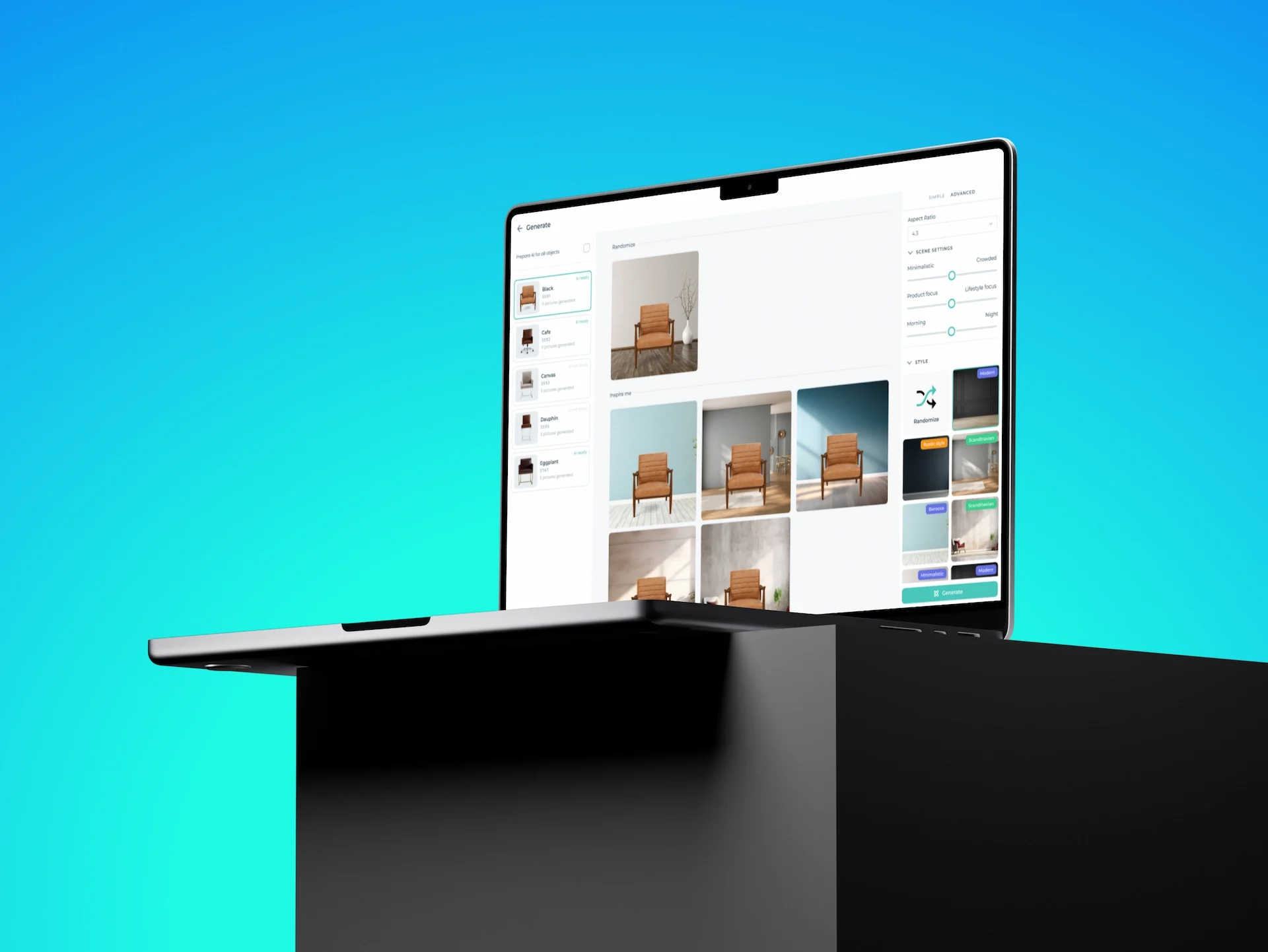
I explored several versions of the generation screen to compare interaction patterns and account for the technology’s constraints. Connecting these variants in a prototype made the trade-offs easier to discuss before development.
Connect the proposed experience.
The final design covers image generation, collections and sharing. It also explores how generated imagery could be reused on product pages through an embedded widget. These screens describe the proposed experience.
The last step was to connect all screens in one prototype in Figma so stakeholders and developers could have an interactive representation of the future piece of software.
A connected prototype for the team to review.
The work produced a connected Figma prototype for stakeholder and developer review. The central design question was how to give users useful controls for image generation within the product's technical constraints. The project was paused before launch.